Palazzo Serafini Sauli (en)

2015-06-22 19:08:50
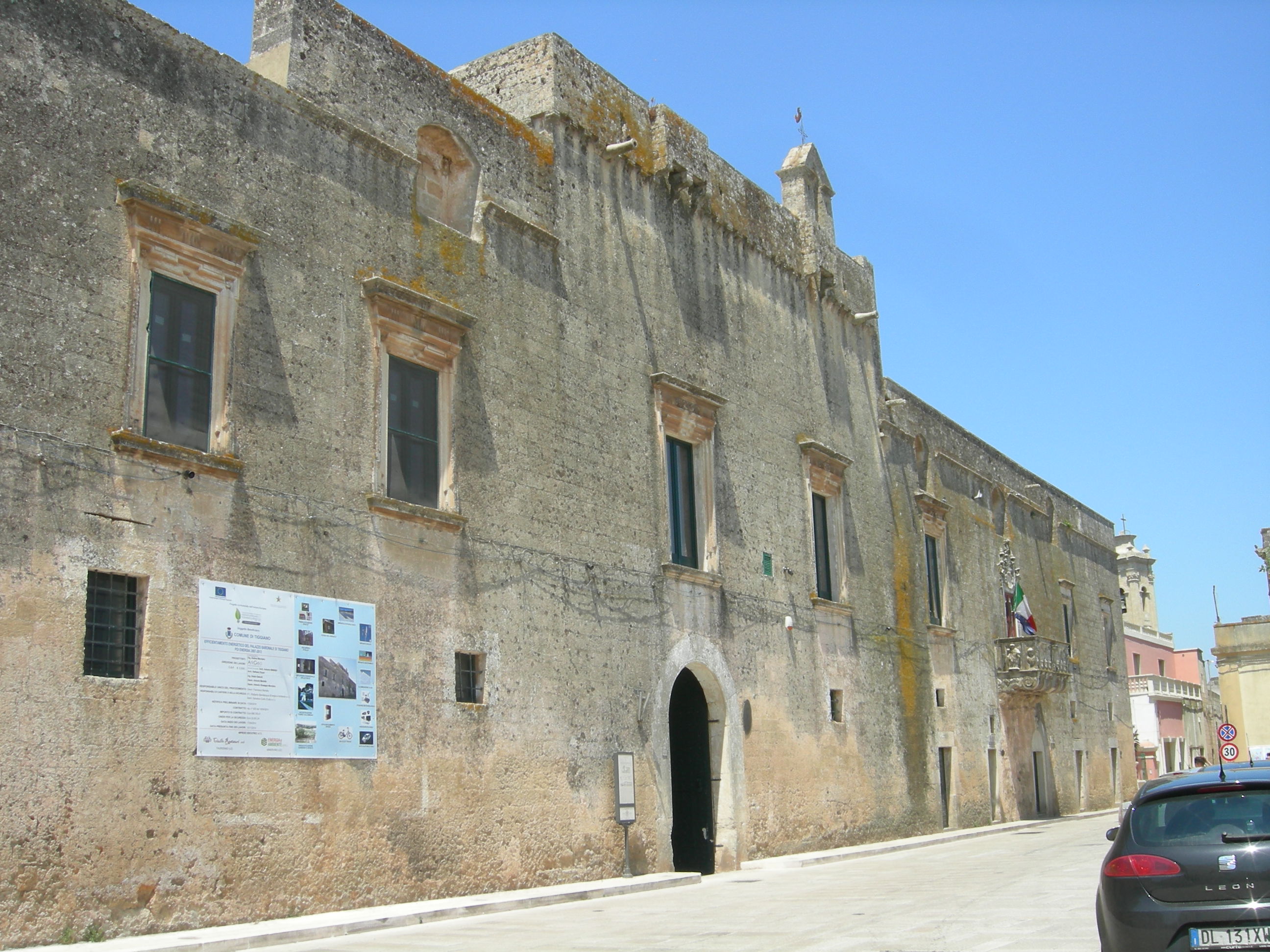
The palace has an impressive façade adorned with an entry portal with a machicolation, a balcony with corbels, finely decorated balustrades, and a belfry. Later, the entrance was moved further south, almost in front of the square.
The palace has two large courtyards: the main entrance leads to the first floor through a staircase where the rooms reserved for the nobility can be found; while on the ground floor were the premises for the servants, the warehouses and stables for animals. At the end of the staircase is the large living room that served as a hall for receptions and ceremonies, wherein a chapel can be found. Adjacent to the living room is the representation space, the only one with two lunettes frescoed with scenes from chivalry life.
The citrus grove is organized according to a system of straight paths, parallel and perpendicular to the central one, and is characterized by an expanse of citrus fruits, among which stand two majestic magnolias and a striking dovecote. The oak woodland is divided by the central route and by the one in four quadrants perpendicular to it, which is marked by rows of pine.
Piazza Castello, Tiggiano
current use:
The palace houses the Municipal Hall and various public offices. Inside, there is also a beautiful Public Garden, the Library and the Museum of Arts and Philosophy. The museum contains numerous items and various tools once used to toil in the fields or for the production of oil and wine. You can see ancient instruments for measuring weight alongside other tools and vintage images that reconstruct the popular traditions, the ancient craft practices and the livelihood in the small town of Salento in between the end of the nineteenth and twentieth centuries.
bibliography sources:
L. A. Montefusco, Le successioni feudali in Terra d'Otranto, Istituto Araldico salentino, Lecce 1994.
R. Margiotta, M. Melcarne, Tiggiano, il Paese, la Chiesa, il Santo, Edizioni Laborgraf, 1995.
AA.VV., Salento. Architetture antiche e siti archeologici, Edizioni del Grifo, 2008.
historical information:
The palace, in the center of the ancient town of Tiggiano, was built in the seventeenth century by Angelo Serafini, who became feudal lord of the town in 1640 and decided to build his home in the area to closely monitor his properties. In the restructuring, the palace incorporated the sixteenth century central tower and reinforced the drains and vents.
Over the centuries, the palace has undergone numerous expansions and renovations.

 Clear routes
 Civil Architecture
 Military Architecture
 Religious Architecture
 Rural Architecture
 Archeology
 Industrial Archaeology
 Landscape and Nature
 Natural Parks
 Site multilayered


